ICSE Class 10 · Board Exam Trends
ICSE 2026 Chemistry: What Three Years of Board Papers Tell Us About Where the Exam Is Heading
A CHEMSAK analysis of ICSE 2024 (T24 522), ICSE 2025 (T25 522), and ICSE 2026 (T26 522)
If you’re an ICSE Class 10 student — or a parent trying to figure out where your child should be spending revision time — the honest answer is that “just revise everything” isn’t a strategy. It’s what you do when you don’t have data. So we pulled apart the last three years of the actual Chemistry (Science Paper–2) board papers, question by question, and mapped every single part-mark to a chapter and to a difficulty level. Here’s what the numbers say.
The two chapters that quietly decide your score
Across all three years, two chapters have consistently made up close to 40% of the paper:
- Study of Compounds (HCl, Ammonia, Nitric Acid, Sulphuric Acid) — averaging 22 marks
- Organic Chemistry — averaging 16 marks
Nothing else comes close. Chemical Bonding, Mole Concept, Electrolysis, and Periodic Properties all hover in the 9–12 mark range, year after year, and Metallurgy and Analytical Chemistry sit at the bottom of the pile with single-digit marks.
What this means practically: if you’re triaging your last month of revision, Study of Compounds and Organic Chemistry are not “one of nine chapters” — they’re closer to two-fifths of the paper on their own. Everything else matters, but these two carry the most weight per hour of study.
The chapter on the way out: Metallurgy
Here’s a trend worth knowing about if your syllabus notes or an older test series still treat Metallurgy as a heavyweight topic: its marks have fallen every single year — 9 → 5 → 3. It hasn’t disappeared, but it’s clearly been de-emphasised by the examiners over this three-year window. If your prep time still mirrors the older papers, you may be over-investing here relative to what’s actually being asked now.
The real story: the exam is getting harder to bluff
This is the finding we think matters most. We sorted every question into four difficulty bands — pure recall, understanding, applied calculation/equation-writing, and higher-order thinking (HOTS: assertion-reason, multi-step deduction, spotting errors in someone else’s reasoning).
| Difficulty Level | 2024 | 2025 | 2026 |
|---|---|---|---|
| Pure Recall | 27% | 14% | 15% |
| Understanding | 20% | 14% | 16% |
| Application (calculations, equations, IUPAC) | 49% | 59% | 48% |
| Higher-Order Thinking (HOTS) | 4% | 13% | 21% |
In 2024, you could genuinely score well by memorising facts and formulas — HOTS content was barely 4% of the paper. By 2025 that had tripled to 13%. The 2026 paper pushes it further still, to a full 21% — roughly a fifth of the entire exam.
That’s not a small shift. It means the paper is moving away from “do you remember it” toward “can you reason through it under pressure” — and that shift shows up in very specific question styles:
- Assertion–Reason questions, which barely existed in 2024, are now a fixture. These trip students up less because they don’t know the chemistry and more because they misread the option (“both true, R explains A” vs “both true, but R doesn’t explain A”). This is a skill you can drill separately from content.
- Multi-step salt/radical identification from a sequence of test-tube observations — present in all three papers, consistently worth marks but demanding layered reasoning.
- “Identify the error” questions, where a student in the paper makes a mistake in a lab procedure and you have to diagnose what went wrong — a newer, more applied style of question than plain recall.
- Reaction-scheme puzzles requiring you to work backward from products to reagents.
So what should you actually do differently?
- Anchor your revision hours to Study of Compounds and Organic Chemistry first — together they’re worth as much as the bottom four chapters combined.
- Don’t skip Metallurgy, but don’t over-invest either — its marks have shrunk for three straight years.
- Practice Assertion–Reason questions specifically, not just the underlying concepts. The failure mode here is almost always technique, not knowledge.
- Build a habit for salt/radical identification questions: write out “test → observation → conclusion” every time, even in practice, so the pattern becomes automatic under exam pressure.
- Treat MCQs with the same seriousness as long-answer questions. A handful of them are now genuinely HOTS-level and deserve real thinking time, not a reflexive guess.
The pattern across three years is consistent enough to trust: ICSE Chemistry is asking students to think with their knowledge, not just recall it. Preparing that way — rather than banking on pure memorisation — is the difference that’s likely to show up most clearly in the 2026 results.
Further Reading
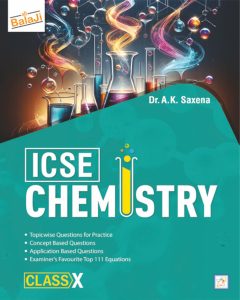
For a deeper bank of competency-based and HOTS-style practice questions covering the chapters and formats discussed above, refer to Dr. A. K. Saxena’s ICSE Chemistry textbook for Class 10, published by Shri Balaji Publication —
view the book here.